RECAP
In my first blog post, I launched a campaign I am working on – to urge drug companies to heed the advice of researchers from Harvard and the Institute for Safe Medicine Practices and sell their dopamine-agonist medication with a clear ‘black box’ warning, outlining the high risks of severe impulse control disorders associated with these medications.
Currently this advice has not been implemented. Instead, they are listed within an entire page of possible side-effects – nausea, sleepiness, low blood pressure, high blood pressure, weight loss, weight gain. Researchers fear this will mean they are overlooked and/or misunderstood – as has been the case for far too many patients.
Researchers called for the separate, ‘black box’ warning, for reasons including
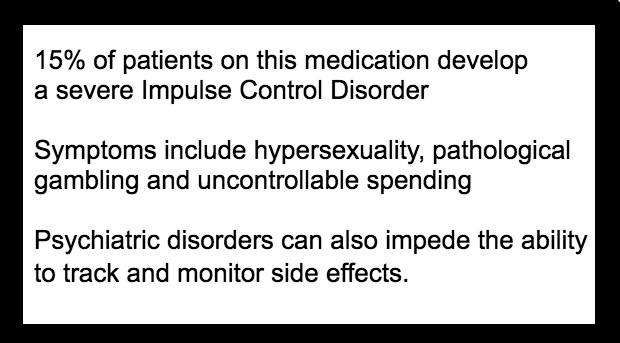
- Very high prevalence rates: measured at 15%, but widely acknowledged this is likely much higher given the difficulty in identifying such cases and patients reluctance to speak to their doctor about them and taboos around mental health.
- Far more destructive impact this can have on people’s lives: known symptoms of pathological gambling, excessive spending and hypersexuality have lead to loss of employment, breakdown of families and relationships, financial ruin, homelessness, even engaging in criminal activity.
- Patient’s inability to track their own side-effects: Psychiatric disorders themselves can impede the patient’s ability to identify their own changes in behaviour, making it very difficult for patients to simply monitor their side-effects and decide to stop taking them if/when they feel these outweigh the benefits (a strategy many people take with medication)
I agree with the researchers and believe their advice should be implemented by drug authorities and manufacturers immediately – allowing patients to make a fully informed decision, and putting aside any impact this could have on what is projected to become a $3.2bn a year market by 2020.
NEXT PHASE
With that in mind, here is something I have been working on as part of this campaign. I have applied my, somewhat rusty, programming skills and created this Twitter ‘bot’.
[Note that this is different to my own Twitter account (@freddiewate)]
What this does is automagically search for and respond to specific tweets that ask about dopamine-agonist medication, brands or active ingredients. It will respond to their tweet with the following message (less than 146 chars!)
“Be informed – researchers want dopamine-agonist PD drugs to carry a Black Box warning for psychiatric disorder side-effects”
This will then (hopefully) lead the person who made the initial tweet to the account profile page, where I have provided further information and links to both the research and my blog.
In effect, I will be trying to fill in for the black box warning in its absence as best I can. Hopefully this will go some way towards raising awareness and informing patients, families and practitioners of the real risks.
Let’s see what happens!
 Freddie Waite