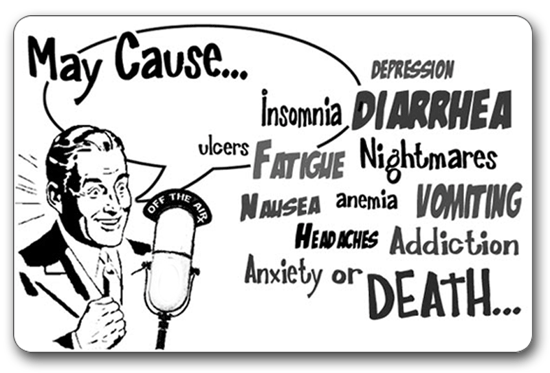
A group of Parkinson’s Disease (PD) medications known as ‘dopamine agonists’ are known to cause impulse control disorders (ICD) so severe that researchers from the Institute for Safe Medicine Practices, Harvard and the University of Ottawa have urged drug companies to carry a ‘black box’ warning on medication packaging, one of the most prominent and serious cautions for prescription drugs.
The researchers’ advice, however, has been ignored. Instead, they are contained amongst a lengthy and confusing entire page of side-effects written within the leaflet inside the packaging, containing every possible side-effect known to man – nausea, sleepiness, weight loss, weight gain, low blood pressure, high blood pressure, etc, etc. Easy to miss, easy to dismiss.
Such behaviours identified by researchers include uncontrollable spending, pathological gambling, hypersexuality and addictions to pornography and prostitutes. This has led to disastrous consequences for patients and their families such as loss of employment, breakdown of families and relationships, financial ruin, even homelessness.
Even more shockingly, in one case earlier this year, dopamine agonist medication was linked to a man’s sudden interest in and possession of child pornography.
Moreover, the circumstances around some of the bizarre behaviours, the shame and embarrassment these can regretfully cause, and taboos around mental health (particularly among the elderly), mean that many sufferers are reluctant to share their stories, or even to speak to their GP about it. Many won’t even have made the connection in the first place.
According to the National Hospital for Neurology and Neurosurgery in the UK, impulse control disorders occur in 15% of patients, although many Parkinson’s nurses believe this figure to be much higher. This is likely, given the mentioned difficulties in identifying such cases.
It’s fair to say, “Hey doctor, I’ve developed a sudden urge to watch pornography all the time”, or “I’ve gambled away all of my wages”, is probably less likely to come up than “Hey doc, why’s my face swollen up?”. Even the question, “Do you find yourself unusually interested in pornography?” may not be answered truthfully by many baby-boomers.
I am writing this article because I have witnessed some of these side-effects in my father, with pretty devastating and traumatic (and expensive!) consequences. His ICD went undetected for well over a year, unfortunately coinciding with the sale of the family home, culminating with a summer spent with psychologists, social workers, police, and multiple bank managers.
My father was first diagnosed with PD in 2009, which unusually came as fantastic news for our family. For a year earlier he was diagnosed with a terminal illness, Progressive Supernuclear Palsy (PSP), and given a prognosis of between two and four years to live. No longer able to work, he retired from a successful career as a maths teacher and author.
Twelve months later, however, confused as to why he hadn’t deteriorated as expected, his doctors tested his response to PD medication. When his symptoms improved, they changed his diagnosis to Parkinson’s, a manageable disease with far more positive outlook. Suddenly, Dad had his life back.
Since then he continued to enjoy his retirement, particularly as it allows him to spend more time doing what he loves – golfing (pretty well for a man in his condition!), spending time with family, and a new passion for fundraising. In 2012 and 2014 he organised, promoted and participated in two charity golf tours through America, playing with fellow PD sufferers, and raising thousands of pounds for the National Brain Appeal. I am immensely proud of my Dad, and still am.
In 2012, his doctors prescribed him with a new drug, Rotigotine, a type of dopamine agonist, marketed by the drug company Neupro. An initial 2mg dosage was was increased in 2015 to 4mg and in 2016 to 6mg. His doctor did not explain the types of behaviours that impulse disorders could cause, nor appropriately differentiate these from the countless of other, mostly fairly harmless, side-effects. At no point was he told he had a 1 in 6 chance of developing a serious impulse control disorder, or what the repercussions of this could be.
Drug companies will naturally seek to protect themselves against every possible lawsuit, hence the long-list of side-effects, but it is undoubtable (and perhaps convenient) that these detract from the the far more serious side-effects (which also include hallucinations and psychosis). The aggregate impression these all give really is that anything can happen, which, somewhat counter-intuitively, probably makes people more likely to try them.
Furthermore, patients certainly expect that they can simply track all side-effects, and stop if and when they decide these outweigh the benefits – however, this is not the case if the medication alters your personality. The “Let’s see how it goes” approach is as naive as it is dangerous when it comes to psychotic disorders.
The difficulty in tracking these side-effects is one of the reasons why researchers advise that physicians also counsel families and carers about impulse control disorders, so they can be vigilant for abnormal behaviours that the patient may not see, or even want to hide. Again, however, this advice has not yet been made standard for these medications.
During 2015, I started to notice my father acting slightly out of character – he seemed distracted, elusive, not himself. However, I would never have expected what would follow. In June 2016, I learnt that he had formed a ‘relationship’ with a woman online, travelled around the world several times to meet her and her ‘business partners’, and was duped into ‘investing’ into a series of financial scams.
After an initial ‘dip in the toe’ investment, an unexpected and urgent follow-on investment was required to save the deal, then another, and so on. This process continued, eventually robbing him of his entire life savings, including the proceeds from the sale of the family home, plus a series of expensive credit card debts – overall parting with over £300,000. Unfortunately, there was nothing the police could do, with the crimes taking place outside of the UK and an unlikely follow-up where the crimes were committed.
As I uncovered what had happened, I was shocked at the amount of time and effort that went into the crime. He seemed as if he’d been completely brainwashed. He was certainly infatuated, and this made him totally manipulable. Whereas anyone else could have seen he was being duped, he truly believed the relationships he formed were real and the investments genuine. He also believed their promises to nurse him when the time came when he could no longer look after himself.
He did appear to have some doubts and concerns along the way, but they had an answer for everything, and these doubts would go out the window in the panic that ensued when a further investment was required. They found a winning formula and they ran with it. For a man in my father’s condition, it was the perfect crime.
When I found out what had happened I took him to his GP and he was referred for a psychiatric assessment, however neither revealed any link to the dopamine agonists he was still taking. And so, without the change in medication, Dad’s strange behaviour continued (be it with less expensive consequences!). He was dishonest, deceitful, evasive, and indifferent – like nothing I had ever seen before – doing whatever he could to reach out to the criminals who had conned him. Whilst he looked like my Dad and sounded like my Dad, he was a completely different person.
I cannot emphasise enough just how out of character this was for my father. He is the most straight-laced and responsible man I know – always putting others first, honest even to his detriment, and priding himself on his integrity. I have strived to be the same in myself. Probably more a ‘glass half empty’ person, sceptical and very much risk-averse; he had never gone into debt in his life (besides a mortgage) and had a perfect credit history.
His behaviour was certainly confusing and frustrating to witness, with many a ‘wtf’ moment! I eventually realised, however, that he simply could not help it. He could be reasoned with by me or the police to see the error in his ways, but when fed an alternative viewpoint (by someone not looking after his interests) he was just as easily taken in that direction – swaying whichever way he was pulled, unable to challenge or disbelieve. Cognitive dissonance, I believe is the medical term.
He was just completely incapable of resisting an urge or impulse – impulses that most healthy people would also feel and acknowledge, but then assess and reject. The part of his brain that performs these last two tasks was simply not functioning. He had lost his free will; he was literally ‘Yes Man’, only someone had figured this out way before I did.
It was soon after realising this that I discovered the link with the medication, about two months after finding out what had happened – a complete penny-drop moment. This actually came as a huge relief – it wasn’t his fault, it offered an explanation, hope, and certainly forgiveness on my part.
His medication was immediately reviewed and amended. It took a while, however eventually these types of behaviours and thoughts started to wear off. So far, not too much to the detriment of his physical mobility, though it is a daunting challenge going forward as to how we manage this looming trade-off.
My father is sadly far from alone in falling victim to these types of side-effects. Some brave people have come forward and discussed their experiences. Many sadly won’t have even made the connection and will remain confused and different people. Many simply won’t want to talk about it. Certainly, a lot of people will find it odd that my father and I are so willing to tell this story. However, the reluctance for people to do so is all part of the problem. We want to raise awareness, and campaign for change.
Far from what some people might think, my father has nothing to be ashamed of. He would never have done the things he did under normal circumstances. The drugs simply altered his mental state. It could happen to anyone. This is certainly an incredibly hard concept for many people to grasp and accept, that they could lose control of their free will and act so differently to their usual character. Indeed, this ignorance, slight arrogance even, undoubtedly adds to the problem.
Fortunately, my father and I both understand mental health more than most, having supported my brother through the mental health difficulties he has experienced as a direct result of a brain haemorrhage he sustained after being punched outside a nightclub in 2006.
As with a blow to the head, neurological drugs similarly change the makeup of our brains, and subsequently change our mental health and change our behaviours. After all, our behaviours, thoughts, decisions and actions are simply a product of the composition of our brains, the health of the cells that make these up, the hormones and chemicals that swirl around them. One thing I’ve learnt over this past decade is that anyone is capable of anything.
Stories like my father’s can be avoided, and certainly better managed. I fear, however, that with PD medication revenues set to increase to $3.2bn by 2020, this presents a clear incentive for drug companies to ignore, play down and confuse researchers’ advice. I, however, believe people have the right to make a fully informed decision. They need to know what to look out for, and to tell their friends and families to look out for, when taking these medications. We also need to continue to break down taboos around mental health, so patients truly understand what can happen, and feel comfortable talking about such problems when they arise.
This article is kicking off my own campaign to raise awareness of these issues and appeal for change. Firstly, I will be calling on drug companies and medical authorities to take on board the advice of professionals and appropriately warn patients about the side-effects with a clear ‘black box’ warning on all packaging, to put people before profits and allow them the right to make a fully educated decision.
I will also be reaching out to the medical profession; GPs need to be fully aware of the worst side effects, and PD physicians need to communicate them clearly to patients, and their families and carers, at the outset – not just to narrate from a pamphlet but to fully detail and explain precisely what they mean and the damage they can cause, to anyone.
I will also be doing everything I can beyond these to inform patients and their families of risks involved, in the hope that future cases like my father’s can be avoided. Please help me by sharing this article with friends and family. Every hour someone in the UK is diagnosed with Parkinson’s – I want these people to know the facts.
Please also get in touch if you have any similar stories, further information, or if you can help or support in any way at all.
Stay tuned for phase 2 of this campaign, to kick off in the next few days!
(Photo: “Cocaine by Adeja Cheek”, by Miss Bonnie Hawkins)
 Freddie Waite